AI in Post-Procedure Skincare: A New Era of Accelerated Healing
Read about AI in Post-Procedure Skincare: A New Era of Accelerated Healing on Cosmi Skin

For decades, the skilled eyes and trained judgment of healthcare professionals have been the gold standard for assessing post-procedure skin healing. This traditional approach, however, is being augmented by a tireless, data-driven intelligence that offers unparalleled precision and predictive insights into patient recovery.
In an age where technology continually redefines what is possible, the field of post-procedure skincare is undergoing a profound revolution. We are moving beyond conventional, often subjective, methods into an era where advanced algorithms enhance every stage of care. Artificial Intelligence is transforming post-procedure skin recovery from a subjective art into a precise, data-driven science, promising accelerated healing and significantly improved patient outcomes.
This article delves into how AI is creating a new era of accelerated healing by providing sophisticated tools that go beyond the capabilities of the human eye. We will explore how AI-powered solutions are revolutionizing wound assessment, allowing for an unprecedented level of detail and consistency in measuring dimensions, classifying tissue types, and detecting subtle signs of infection. You will discover how sophisticated predictive analytics, fueled by machine learning, can forecast healing trajectories, empowering clinicians to intervene proactively and tailor treatments with greater accuracy than ever before. Furthermore, we will examine AI
TL;DR
Assessing skin recovery after a procedure has long relied on subjective clinical observation. Artificial intelligence is now introducing a new standard of precision and predictability to this critical process.
AI is fundamentally shifting post-procedure skin care from a reactive, observation-based model to a proactive and personalized framework. By analyzing digital images, these systems can objectively measure wound characteristics, classify tissue, and use predictive analytics to forecast healing timelines, enabling early intervention. This data-driven approach improves assessment accuracy and consistency over traditional methods, a finding supported by research in the Journal of Investigative Dermatology (2023).
Key applications transforming patient care include:
- Precise Assessment: AI models accurately measure wound dimensions and differentiate tissue types like granulation or necrotic tissue from photos.
- Proactive Intervention: Machine learning algorithms forecast healing trajectories, flagging patients who may be at risk for complications.
- Remote Monitoring: Mobile health apps use AI to automatically triage patient-submitted images, optimizing clinical follow-up.
- Automated Treatment: Emerging smart bioelectronics can monitor a wound and dynamically adjust treatment in a closed-loop system.
Ultimately, integrating AI into post-procedure protocols offers a powerful tool to enhance patient outcomes, streamline clinical workflows, and personalize recovery at scale.
Why Traditional Post-Procedure Skin Assessment Falls Short
Optimal healing after a medical procedure is paramount for patient well-being. However, conventional methods for monitoring skin recovery are frequently subjective and inefficient, creating significant challenges in the healing journey.
Traditional wound assessment relies heavily on manual visual estimation and basic tools, introducing considerable inter-clinician variability and making consistent long-term monitoring difficult. For instance, ruler-based measurements, which are often imprecise, can overestimate wound size by as much as 40% (Le & Pham, 2023), providing inaccurate data on healing trajectories. Such inaccuracies can lead to improper dressing selection, overlooked non-healing wounds, and delayed specialist referrals. Furthermore, the intermittent nature of in-person follow-ups often delays the detection of complications like surgical site infections (Chen et al., 2024), prolonging recovery.
The economic burden of managing chronic and post-surgical wounds is substantial. The United States alone incurs costs ranging from $28.1 to $96.8 billion annually for these conditions and their complications (Stefanelli et al., 2025). This financial strain is partly driven by inefficient monitoring processes and the costly management of preventable issues stemming from delayed intervention.
Note: The inherent subjectivity and imprecision of conventional wound assessment methods create a critical gap, often leading to suboptimal care and increased healthcare expenditures.
The limitations of traditional skin assessment underscore a profound need for objective, data-driven solutions to enhance patient care and optimize recovery outcomes.
AI-Powered Assessment: Seeing Beyond the Naked Eye
Effective healing begins with an accurate assessment, yet the human eye can be subjective. Traditional methods rely on estimations that can vary between clinicians or even from one day to the next for the same observer.
AI-powered analysis transforms this process from a manual art into a precise, automated science. It uses advanced deep learning models, specifically a type of AI called a Convolutional Neural Network (CNN), to interpret skin images with exceptional consistency. The first step is semantic segmentation, where the algorithm creates a perfect, pixel-by-pixel digital outline of the procedure area. This automated process precisely calculates the wound's surface area and perimeter, eliminating the guesswork inherent in using a ruler.
The analysis then goes deeper by performing tissue classification, examining every pixel within that segmented border. It intelligently categorizes the tissue into distinct types crucial for understanding the healing stage: healthy granulation tissue, new epithelialization, slough (non-viable tissue), or necrosis. This provides a comprehensive, objective snapshot of the wound's composition, offering insights that are difficult to quantify consistently by eye alone. This automated data capture creates a reliable, reproducible baseline for meticulously tracking healing progress over time.
The accuracy of this technology is validated by extensive research. A study highlighted by Stefanelli et al. (2025) found that an AI segmentation model achieved a DICE score—a standard metric for accuracy—of 92%, indicating a near-perfect overlap with outlines drawn by clinical experts. The same model demonstrated a mean DICE score of 78% for classifying different tissue types, showcasing its robust analytical capabilities. Further supporting this, the Mayo Clinic News network described an AI tool that could detect the presence of a surgical incision in patient photos with 94% accuracy, a vital first step for remote monitoring. Studies like those from Chen et al. (2024) continue to affirm that deep learning provides a more consistent and detailed approach to wound evaluation.
The following table compares AI-powered assessment to traditional methods across key evaluation metrics.
| Feature | Traditional Assessment | AI-Powered Assessment | Key Benefit |
|---|---|---|---|
| Area Measurement | Manual estimation with a ruler; prone to error and variability. | Automated pixel-based calculation; highly precise and repeatable. | Objective data for accurate size tracking. |
| Tissue Analysis | Subjective visual judgment of tissue types and percentages. | Algorithmic classification of tissue (e.g., granulation, slough). | Quantified, data-driven insight into healing quality. |
| Consistency | High variability between different observers and even the same observer over time. | Standardized analysis provides identical results for the same image every time. | Reliable, unbiased progress monitoring. |
| Data Logging | Manual charting, notes, and photos stored separately. | Data is automatically captured, quantified, and logged for trend analysis. | Seamless and efficient creation of a detailed healing record. |
By transforming subjective visual checks into objective, quantifiable data, AI assessment establishes a reliable foundation for personalized and effective post-procedure recovery plans.
From Assessment to Prediction: How AI Forecasts Healing Trajectories
Beyond capturing a single moment in time, AI can forecast the trajectory of skin recovery. This leap from static assessment to dynamic forecasting is transforming the management of post-procedure care.
This predictive power comes from sophisticated machine learning algorithms trained on vast datasets. These models learn to recognize complex patterns that correlate with different healing outcomes by synthesizing a multitude of inputs: high-resolution images of the treatment area, structured data from electronic medical records (EMRs) like patient age and comorbidities, and even lifestyle factors. By analyzing these variables collectively, the AI generates a personalized healing trajectory, moving care beyond population averages to individual predictions.
The scale of this analysis is critical for its accuracy. A review by Chen et al. (2024) discusses a model trained on an immense dataset of over 620,000 chronic wounds. This model learned to predict, with high confidence, whether a wound was likely to heal within a 12-week timeframe. The research underscores a key finding: specific wound characteristics, such as initial surface area, depth, and location, are often stronger predictors of healing than more general patient health metrics. This allows for a highly focused risk assessment.
This precision is invaluable in specialized areas like burn care, where accurately judging burn depth is essential for determining treatment and predicting healing time. As detailed by Le & Pham (2023), AI models using convolutional neural networks (CNNs) can analyze a photograph of a burn and classify its depth far more consistently than the human eye. This objective data directly feeds into more reliable predictions for recovery and guides decisions about surgical intervention.
Key Insight: The true value of predictive AI is not just in knowing if a wound will heal, but in identifying which wounds are at high risk of delayed healing before complications arise. This foresight enables early, targeted interventions that can significantly alter the recovery trajectory.

This predictive foresight enables a fundamental shift in clinical workflow. Instead of adhering to a standard follow-up schedule, clinicians can allocate resources more effectively. A patient whose recovery is predicted to be straightforward may require fewer check-ins, while an individual flagged as high-risk can be monitored more closely from the outset. This proactive stance allows for timely adjustments to the care plan. For instance, if an AI predicts slow epithelialization after a laser resurfacing procedure, a clinician might preemptively introduce a specialized growth factor serum. This data-driven approach minimizes trial-and-error, leading to faster, more predictable healing.
**AI
AI in Action: Enhancing Remote Care and Detecting Infections
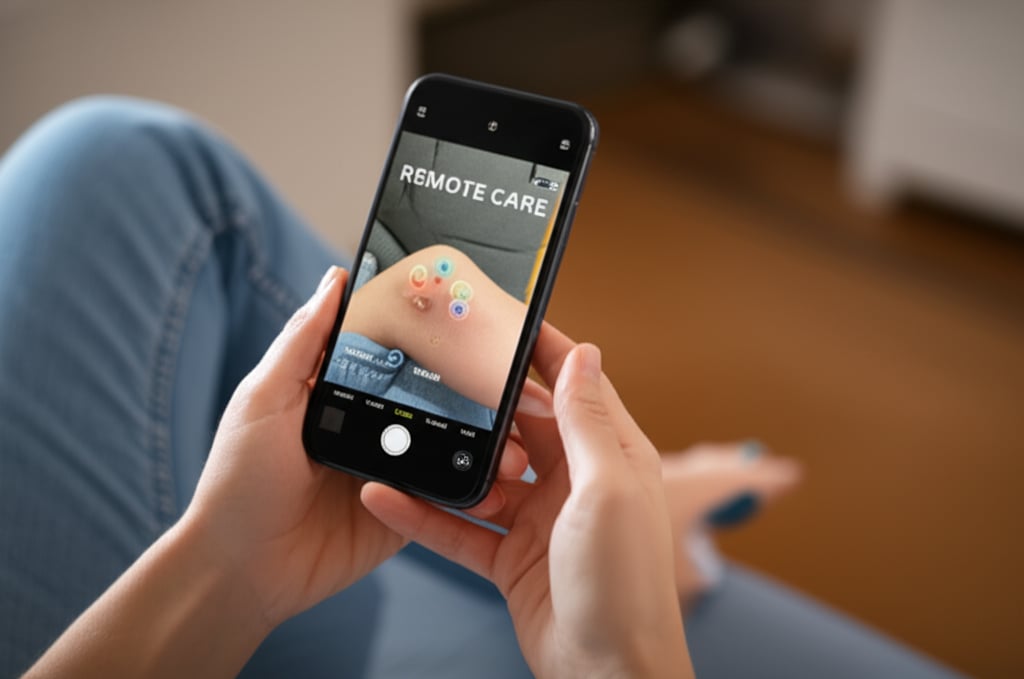
The days following a procedure are critical for healing, yet traditional follow-up appointments can be infrequent and inconvenient. AI-powered remote monitoring delivers expert oversight directly through a smartphone, helping ensure recovery stays on track.
Through intuitive mobile applications, patients can securely submit photos of their post-procedure site for immediate analysis. These systems use sophisticated computer vision algorithms to evaluate the images for subtle signs of complications, such as emerging Surgical Site Infections (SSIs). The AI acts as a vigilant first line of defense, analyzing factors like changes in redness, swelling, and wound discharge characteristics with a precision that can surpass casual human observation.
This intelligent triage fundamentally transforms post-procedure care. It decentralizes the process, empowering patients to become active participants in their recovery from home while streamlining clinical workflows. By prioritizing cases that require urgent intervention, clinicians can manage a larger patient population more effectively. This shift improves both efficiency and patient safety through early detection, as some systems can process an image in a fraction of a second (BMC Med Inform Decis Mak 2025).
The clinical viability of this technology is well-documented. Researchers at the Mayo Clinic developed an AI system using a Vision Transformer model to detect SSIs from patient-submitted photos. Trained on a diverse dataset of over 20,000 images from more than 6,000 patients, the model demonstrated a high level of diagnostic accuracy. Its ability to distinguish between healing and infected sites was measured at an 81% area under the curve (AUC), a strong statistical indicator of reliability ([Chen et al., Am J Translational Research 2024]).
This technology is also a powerful tool for health equity. Patients in rural or underserved communities, who may face significant barriers to accessing follow-up care, can receive the same level of diligent monitoring as those near major medical centers. It reduces the financial and logistical burden of travel and time off from work, making high-quality post-procedure care more accessible.
Note: These AI systems are designed to augment, not replace, clinical expertise. By intelligently filtering and prioritizing patient submissions, the technology empowers medical professionals to apply their skills where they are most needed. This collaborative human-AI approach leads to a more responsive, efficient, and patient-centered care model.
By bringing expert-level analysis directly to the patient, AI-driven remote monitoring is making post-procedure recovery safer, more accessible, and more efficient.
The Next Frontier: AI-Feedback Bioelectronics
Beyond analysis and monitoring, the future of AI in skin recovery involves devices that actively participate in the healing process. This represents a shift from passive observation to dynamic, automated intervention.
The most advanced research is focused on AI-feedback bioelectronics
Recent innovations highlight the potential of these smart materials. Researchers are developing regenerative bioelectronics where an AI dynamically controls treatment based on the wound's healing stage (Chen et al., Am J Transl Res 2024). One such system detailed by Yuan et al. (Cell Biomaterials 2025) uses an AI-controlled hydrogel patch that modulates electrical currents to manage healing in two distinct phases.
- Early Stage (Infection Control): The AI detects signs of infection and applies a higher electrical current (4 mA). This current triggers the release of antimicrobial gallium ions from the hydrogel, directly combating pathogens.
- Late Stage (Tissue Regeneration): As the wound improves, the AI senses this change and reduces the current to a lower level (0

The ultimate evolution of AI in skin recovery is the creation of closed-loop bioelectronic systems where AI not only assesses but actively and autonomously directs the healing process.
Implementing AI in Clinical Practice: Challenges and Outlook
While the potential for AI to enhance post-procedure care is significant, the path from algorithm to bedside involves practical challenges. Successfully integrating AI into routine wound care requires overcoming considerable data, regulatory, and workflow hurdles.
The core difficulty lies in bridging the gap between technological innovation and clinical application. A primary barrier is the availability of large, diverse, and well-annotated datasets, which are essential for training accurate models but are difficult to acquire due to patient privacy regulations and data-sharing hesitancy (Chen et al., 2024). Furthermore, even the most advanced tools are ineffective if they disrupt established clinical processes or add to a clinician's administrative burden.
Navigating the path to widespread adoption involves addressing several key areas:
- Data & Privacy: Securing high-quality data while adhering to strict patient privacy laws remains a foundational challenge. AI models trained on limited or biased datasets risk producing inequitable or inaccurate recommendations.
- Clinical Integration: For AI to be useful, it must integrate seamlessly into existing Electronic Health Record (EHR) systems and support, not complicate, the clinician's decision-making process.
- Regulatory Approval: AI tools intended for diagnosis or treatment guidance are often classified as medical devices and require rigorous validation and formal approval from bodies like the FDA to ensure they are safe and effective.
- Building Trust: Clinicians must be able to trust and understand AI-driven recommendations. This involves addressing ethical concerns around accountability for AI-driven errors and ensuring algorithmic fairness.
The rise of Explainable AI (XAI) is crucial for overcoming the trust barrier, offering transparency into how a model arrives at its conclusions, a step considered vital for gaining clinical acceptance (Le & Pham, 2023). By making AI's reasoning understandable, clinicians can more confidently incorporate these powerful tools into their practice.
Despite these obstacles, the continued development of transparent, validated, and well-integrated AI systems promises a future where post-procedure care is more precise, efficient, and personalized.
The journey through post-procedure recovery is evolving, moving from traditional, often subjective methods to an era of unparalleled precision and personalization driven by Artificial Intelligence.
Here are the key takeaways from this new frontier:
- Precision Assessment: AI transforms skin evaluation from a subjective art into a precise, data-driven science. Advanced algorithms accurately measure wound dimensions, classify tissue types, and detect early signs of infection from digital images with high consistency.
- Predictive Healing: Machine learning models provide powerful predictive analytics, forecasting healing timelines. This allows clinicians to identify at-risk patients proactively and intervene early, preventing complications and optimizing recovery.
- Dynamic Care & Bioelectronics: AI is enhancing remote patient monitoring through smart applications and is set to revolutionize treatment with AI-feedback bioelectronics
This integration of AI is not merely an advancement; it represents a fundamental shift towards more personalized, efficient, and ultimately, more effective post-procedure care. By embracing these intelligent technologies, we are stepping into an era where every patient can experience a recovery journey tailored to their unique needs. For healthcare professionals, staying abreast of these developments is essential for effective and ethical integration. For patients, understanding these capabilities can empower informed discussions with providers about optimizing their healing journey. The future of accelerated, intelligent healing is here.
Tags
Related Articles

AI Skin Profiling: Your Essential Guide from Data to Dermatologist
AI in Skincare: Unlock Your Best Complexion with Cosmi