
Affiliate Roundup Vs Diagnostic Match Which Skincare Advice Fits
Read about Affiliate Roundup Vs Diagnostic Match Which Skincare Advice Fits on Cosmi Skin
You searched "best vitamin C serum 2026" and the first page is a wall of listicles. Every one claims to be editor-tested. Every one links to a retailer. Many of them are honest, well-written, and genuinely helpful. But none of them asked what your skin looks like this morning.
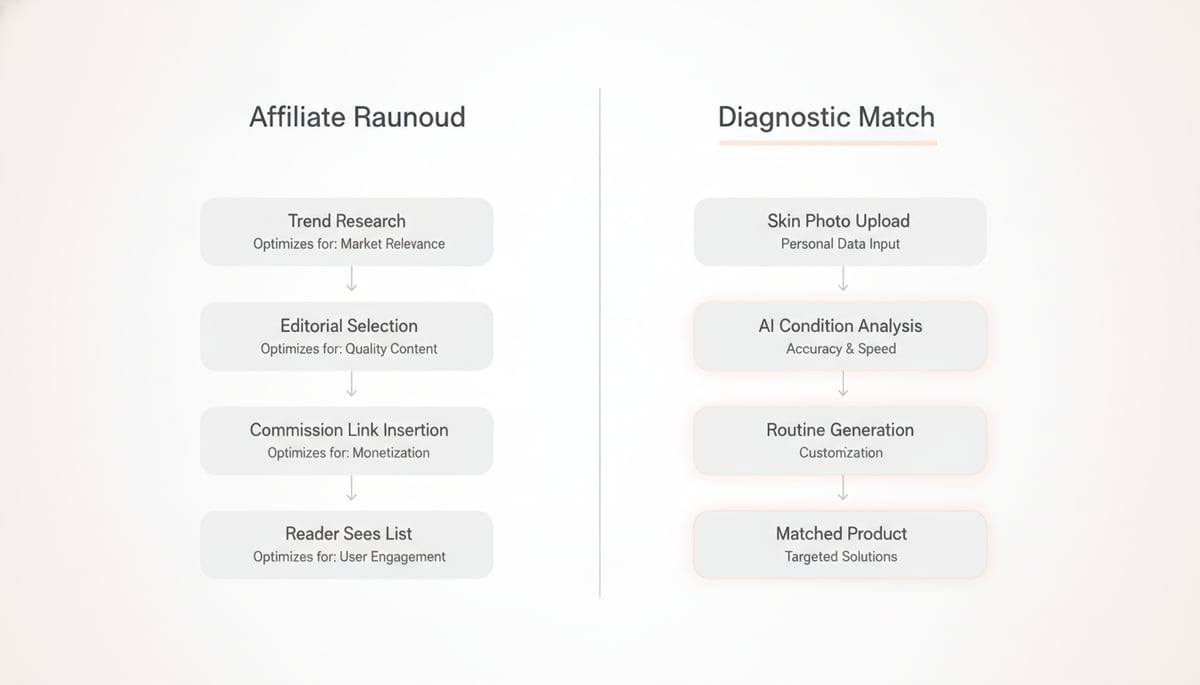
That gap is the whole story. An affiliate skincare roundup and a diagnostic product match can sit on the same results page and feel similar, but they answer fundamentally different questions. One answers "what products sell well and convert clicks?" The other answers "what does this specific person's skin need right now?" Understanding which type you are reading changes how you should use the advice.
TL;DR: Affiliate Roundup vs Diagnostic Product Match
| Dimension | Affiliate Roundup | Diagnostic Product Match |
|---|---|---|
| Primary input | Search trends, bestseller data, commission rates | Your analyzed skin profile (acne, hydration, wrinkles, etc.) |
| What's optimized | Click-through and conversion | Match accuracy to your skin conditions |
| Personalization level | Generic or category-based ("best for oily skin") | Individual, derived from your data |
| Selection logic | Commission rate, retail partnerships, editorial taste | Condition-to-ingredient mapping, routine context |
| Adjusts over time? | No, the list is fixed at publish | Yes, as your skin analysis updates |
| Tied to a routine? | Rarely | Usually, recommendations slot into a daily structure |
| Disclosure requirement | FTC "clear and conspicuous" disclosure of material connection | Not applicable, since no third-party payment |
| Failure mode | Great products, wrong skin match | Limited by quality of the diagnostic input |
Key Takeaway: The product quality in both models can be identical. The difference lives in the input: affiliate lists optimize for commerce, diagnostic matches optimize for fit.
Next up: a clear breakdown of how each model actually works behind the scenes.
How an Affiliate Skincare Roundup Actually Works
An affiliate roundup is a piece of editorial content, whether an article, video, or social post, that recommends a curated set of products where the creator earns a commission when readers purchase through tracked links. This is the dominant business model in beauty publishing. Skincare is one of the strongest categories for affiliate revenue because of high repeat-purchase rates and premium price points, according to Skimlinks' 2026 beauty affiliate analysis.
The mechanics are usually invisible to the reader but matter a lot:
- Editorial selection. A writer or editor chooses products to feature. The selection can be rigorous or thin, but it almost always happens before any individual reader's skin is considered.
- Affiliate link insertion. Each product link carries a tracking code. A commission fires when someone buys.
- Disclosure. The FTC requires "clear and conspicuous" disclosure of any material connection (payment, free product, or affiliate commission) between the recommender and the brand. This is the law, not a courtesy (FTC 2026 disclosure guide).
- Conversion optimization. Because revenue depends on clicks and sales, the roundup is often structured around products with strong consumer demand, high search volume, or above-average commission rates.
What an affiliate roundup is genuinely good at: surfacing what is broadly popular, introducing readers to brands they have not heard of, and consolidating many products into one searchable page. Major publications like Allure build in editorial rigor: ingredient vetting, multi-editor testing, and dermatologist review that goes well beyond a basic affiliate post.
What an affiliate roundup is not designed to do: tell you whether the products on the list are right for your skin in particular. The list is the same for every reader.
Key Takeaway: Affiliate roundups are commerce content. They can be ethical, well-researched, and useful for discovery, but their selection criteria are not built around your skin.
Next up: what changes when a recommendation is generated from your actual skin data instead.
How a Diagnostic Product Match Actually Works
A diagnostic product match starts with an assessment of your skin, typically an AI-driven image analysis, a structured questionnaire, or both. The assessment produces a profile of your current conditions: acne severity, hydration level, wrinkle depth, pigmentation, sensitivity signals, and similar measurable markers. From that profile, the system maps specific products (or ingredients) to the conditions it found.
On Cosmi, this workflow looks like this:
- Skin analysis. You upload photos and answer a few targeted questions. Our AI reads the images for conditions including acne, hydration, and wrinkles. The output is a scored profile, not a guess.
- Routine generation. Based on that profile, the platform builds a structured routine (morning, afternoon, and evening) where each step has a stated purpose tied back to your analysis.
- Smart product recommendations. Inside that routine, we surface curated products matched to the conditions your analysis flagged. If hydration is low and acne is active, the recommendations are different from a profile where hydration is low and acne is quiet.
- Tracking over time. As you log new analyses, the recommendations can shift. If your hydration score improves, the routine and product picks adapt.
The crucial structural difference: the input is your skin data, and the output is derived from that input. Nothing in the loop is selected because it converts well in someone else's shopping session.
Key Takeaway: A diagnostic match is not a better list. It is a different pipeline. The products are downstream of your skin profile, not upstream of it.
Next up: a closer look at the trade-offs each model carries.
Where Each Model Breaks Down
A fair comparison has to acknowledge where each approach fails, not just where it wins.
Affiliate roundups, even good ones, have structural blind spots
- Best-selling is not best-for-you. A product can dominate sales because of packaging, marketing, or viral moments, none of which correlate with whether it suits your specific skin profile.
- Commission bias is real, even when unintentional. Higher-commission products naturally get more promotional real estate in affiliate-driven publications. Disclosure handles the transparency requirement, but it does not erase the incentive structure.
- Lists do not age well with your skin. Your skin changes with season, stress, hormones, and routine adjustments. A 2026 roundup cannot know about the barrier disruption you had in March.
Diagnostic matches, including ours, have honest limits
- The output is only as good as the input. If your photo is poor lighting or low resolution, the analysis is weaker. Cosmi is no exception here.
- AI is not a dermatologist. A diagnostic platform can read visible markers from an image, but it cannot diagnose medical skin conditions or replace in-person evaluation for concerns like suspicious moles, eczema flares, or prescription needs.
- Personalization depends on routine adherence. A matched product only works if it is actually used consistently in the routine context it was placed in.
Key Takeaway: Affiliate lists fail at personalization. Diagnostic systems fail at edge cases and medical nuance. Neither is a complete answer on its own, which is why the right question is not "which one is better" but "which one fits this decision?"
Next up: how to evaluate any product recommendation you encounter, regardless of its source.
A Reader's Framework: How to Tell What You're Reading
Before you click "add to cart" on the third serum of the month, run the recommendation through four checks. These apply whether the source is an affiliate roundup, a diagnostic platform, or somewhere in between.
1. What was the input?
If the answer is "trends, bestseller lists, editorial taste," you are reading a curated recommendation. Useful for discovery. Not personalized.
If the answer is "your analyzed skin data," you are reading a matched recommendation. Useful for fit. Depends on input quality.
2. What was the selection criteria?
Affiliate lists are usually optimized for traffic and conversion. Diagnostic lists are usually optimized for condition-to-ingredient fit. Neither optimization is hidden, but the difference matters.
3. Does it fit your routine context?
A great product recommendation that contradicts your existing routine (wrong time of day, conflicting active ingredients, wrong pH order) is a worse recommendation than a less glamorous one that slots in cleanly. Affiliate lists rarely address routine context. Diagnostic systems usually do.
4. Can it adjust?
Your skin in January is not your skin in July. A static list cannot change. A diagnostic system that tracks and re-analyzes can.
Key Takeaway: The most useful question is not "is this article trustworthy?" but "is this recommendation responding to my skin, or to the broader market?"
Next up: where Cosmi specifically sits in this comparison.
What Cosmi's Recommendation Engine Actually Does Differently
We are not the only diagnostic tool in skincare, and we are not shy about saying where the field is moving faster than we are. What we can describe specifically is how our own pipeline works, because we built it and we run it every day.
- The analysis covers measurable conditions. Acne, hydration, and wrinkles are the three core categories our AI reads from submitted photos. These are observable, trackable markers, not vague skin "types."
- The routine is structured, not freestyle. Cosmi generates morning, afternoon, and evening routines as distinct blocks. Each step exists because the analysis flagged a condition it addresses.
- Product recommendations are slotted into that routine. A product recommendation inside Cosmi is not a standalone list. It is placed in a routine step, with the condition it targets shown alongside it. If two conditions need different products at the same time of day, the platform surfaces that tradeoff rather than picking one arbitrarily.
- Tracking closes the loop. When you re-analyze, the same conditions are re-measured. Over time, you can see whether your hydration score, acne activity, or wrinkle markers have moved. The recommendations can shift accordingly.
That last point is what we think matters most for this comparison. An affiliate roundup is a snapshot. A diagnostic platform with tracking is a feedback loop. The product list changes when your skin changes, not when a brand sends a new PR package.
For a closer look at the platform's analysis layer, see how AI skin analysis works on Cosmi, and for the routine generation side, our personalized skincare routine guide walks through how the morning, afternoon, and evening structure gets built.
Key Takeaway: Cosmi is not selling a better product list. We are running a pipeline that starts with your skin data and ends with a routine that adjusts as your skin changes.
Next up: when to use which.
When an Affiliate Roundup Is the Right Tool
We are not arguing against affiliate content. It has a place, and pretending otherwise would be dishonest.
Affiliate roundups are useful when you are:
- Browsing or discovering new brands, categories, or product formats you have not tried.
- Comparing mainstream options within a category, like "best ceramide moisturizers under $40."
- Looking for cultural signal: what is trending, what is winning awards, what is selling well.
- Doing initial research before committing to a more personalized assessment.
In those moments, an affiliate roundup is a starting point. The mistake is treating it as an endpoint.
When a Diagnostic Match Is the Right Tool
A diagnostic platform earns its keep when you are:
- Frustrated with trial and error and you have already cycled through multiple products that did not work.
- Tracking a specific concern (acne, persistent dehydration, early wrinkles) where condition-level data matters more than brand awareness.
- Building a routine from scratch and you do not know what your skin actually needs in the morning versus at night.
- Adjusting over time because your environment, hormones, or seasons change how your skin behaves.
For readers in that second camp, affiliate lists are noise. You need input that reflects your skin, not input that reflects the broader market.
The One Thing to Remember
Affiliate roundups and diagnostic product matches both recommend skincare products. They look similar on the surface. But they optimize for different things.
- An affiliate roundup optimizes for clicks, conversion, and commerce. The output is the same list for every reader.
- A diagnostic match optimizes for fit between the product and your analyzed skin profile. The output shifts as your skin shifts.
If you remember nothing else from this article, remember that the difference is not in the products. The difference is in the input. Pick the recommendation style that matches the question you are actually trying to answer.
If your question is "what is everyone buying right now," an affiliate roundup is fine. If your question is "what does my skin need," it is the wrong tool for the job.