How AI Learns Your Skin: The Journey from Data to Glow
Read about How AI Learns Your Skin: The Journey from Data to Glow on Cosmi Skin
What if the secret to healthy, glowing skin was not in a new product, but in a deeper understanding of your unique complexion? For years, skincare advice has often been generic, a one-size-fits-all approach that rarely delivered on the promise of personalized results. We have navigated endless aisles and tried countless regimens, often wondering if we were truly addressing our skin's specific needs.
Today, the landscape of skincare is undergoing a significant transformation, powered by the capabilities of Artificial Intelligence. This is not science fiction; it is a rapidly evolving reality where sophisticated algorithms learn to "see" and interpret skin with a high level of detail and accuracy. This technology promises to move us beyond guesswork, offering a future where skincare is not only effective but truly intelligent.
This post will demystify how artificial intelligence, particularly deep learning, analyzes complex skin data to provide personalized care and pave the way for a healthier future. We will explore how AI functions as a digital dermatologist, the methods it uses to interpret vast amounts of skin data, and the intricate process of training these models. You will discover the real-world applications transforming beauty and health, as well as the crucial challenges AI faces in ensuring fairness across diverse skin tones.
TL;DR
Ever wonder how an app can analyze your skin with just a photo? The answer lies in a sophisticated journey from data to diagnosis, transforming pixels into personalized insights.
Artificial intelligence is reshaping dermatology by learning to interpret skin images with remarkable precision. This technology uses vast datasets to recognize patterns associated with various conditions, from common acne to melanoma. The goal is to provide personalized care and powerful diagnostic support that can be accessed from anywhere.
The process relies on deep learning models that are trained and validated against expert dermatological diagnoses, a methodology frequently explored in publications like MDPI Diagnostics (2023). Key challenges remain, including overcoming data bias to ensure models work equally well for all skin tones.
- Data Collection: Gathering thousands of diverse, labeled skin images.
- Model Training: Teaching AI to identify features like texture, color, and shape using architectures like Convolutional Neural Networks.
- Validation: Testing the AI against dermatologist assessments for accuracy and safety.
- Application: Deploying the AI for tasks like product recommendations and early disease detection support.
By transforming pixels into predictions, AI offers a powerful new lens for understanding and caring for our skin.
The Fuel for the Engine: How AI Gathers Skin Data
An AI model is only as smart as the data it learns from. In dermatology, this data consists of a vast and meticulously curated library of skin images that forms the very foundation of its intelligence.
The performance of any skin analysis AI is directly tied to the quality, diversity, and scale of its training dataset. This collection teaches the model to recognize the subtle visual language of skin, from the texture of eczema to the asymmetry of a mole. Without a rich and varied dataset, an AI cannot generalize its knowledge to new, unseen skin conditions, making high-quality data the most critical asset in its development.

To build this foundation, researchers use two primary types of images. The first is dermoscopic imagery, captured with a specialized magnifying tool that reveals subsurface skin structures. The second is standard clinical photography, often captured with high-resolution cameras or smartphones. This second category is crucial, as noted by research in ScienceDirect (2022), because models must perform well on the kinds of images users can easily capture themselves.
| Image Type | Description | Primary Use Case | Key Datasets |
|---|---|---|---|
| Dermoscopic | High-magnification images showing subsurface skin patterns. | Training models for clinical-grade diagnostics, especially for pigmented lesions. | ISIC Archive, HAM10000 |
| Clinical/Mobile | Standard photographs taken without magnification. | Developing accessible consumer applications and teledermatology tools. | PAD-UFES-20 |
Before an AI can learn, this data must be prepared. The first step is annotation, a painstaking process where dermatologists label each image with a verified diagnosis, creating the "ground truth" the AI will learn from. Public archives like the HAM10000 dataset, with its 10,015 images across seven lesion categories, are benchmarks in the field because of their high-quality annotations.
Next comes pre-processing. Images are algorithmically cleaned to remove visual noise, using computer vision techniques such as using Black-Hat transformation to digitally remove hair. The dataset is then expanded through data augmentation—creating new training examples by slightly altering existing images, such as rotating or flipping them. This technique makes the model more robust and less likely to be thrown off by variations in lighting or angle.
Ultimately, the performance of a sophisticated AI model rests on the foundational principle of high-quality, expertly prepared data.
The Brains of the Operation: Training a Skin-Smart AI
Once the data is prepared, the real learning begins. This is where a model develops its intelligence, transforming from a blank slate into a sophisticated skin analysis tool through an intensive training process.
The "brain" of a skin-analyzing AI is a deep learning architecture designed for visual recognition. For years, the gold standard has been Convolutional Neural Networks (CNNs). These models process an image through layers of digital filters, learning to recognize simple features like edges and colors before combining them to identify complex patterns like lesion borders and textures. Renowned CNN models such as ResNet, Inception, and Xception have become workhorses in dermatological AI.

Their ability to learn intricate visual features makes them exceptionally well-suited for classifying skin conditions. In fact, studies published by PMC NCBI (2024) have shown their performance can be on par with board-certified dermatologists for specific tasks like melanoma detection. More recently, Transformer-based models like the Swin Transformer have also shown impressive results, achieving high accuracy across dozens of disease classes on mobile-acquired images by better understanding the overall context of a photo.
Few of these powerful models are trained entirely from scratch. A more common and efficient method is transfer learning. This technique takes a model that has already been trained on millions of general images and fine-tunes it using a specific medical dataset. This gives the model a significant head start, and through this process, specialized models targeting conditions from acne to atopic dermatitis have reached accuracies between 90% and 94%.
Note: The training process is an iterative loop. The model makes a prediction on an image, compares it to the dermatologist's label, and calculates an 'error' or 'loss'. It then adjusts its internal parameters to minimize this error, repeating the process thousands of times until its predictions become consistently accurate.
This rigorous cycle of trial and error allows the AI to slowly refine its understanding, much like a medical student learning to identify conditions through repetition and feedback. The end result is a highly specialized tool capable of recognizing nuanced visual patterns that might be missed by the untrained eye.
This meticulous cycle of prediction, error correction, and refinement is how an AI gradually builds an expert-level ability to visually interpret skin.
From Lab to Life: AI's Real-World Skincare Applications
The artificial intelligence analyzing your selfie for signs of aging is a distant cousin to the one assisting a doctor in screening for skin cancer. Though they share a common technological ancestry, their purpose, precision, and the environments in which they operate are worlds apart.
These two applications represent a critical split in dermatological technology. Clinical AI is developed for high-stakes medical diagnostics, where its primary function is to identify pathologies like melanoma with the highest possible degree of accuracy. Consumer-facing AI, in contrast, focuses on aesthetic and wellness concerns—analyzing factors like wrinkles, hydration, and pigmentation to provide personalized skincare advice. The data, objectives, and standards for validation in these two realms are fundamentally different.
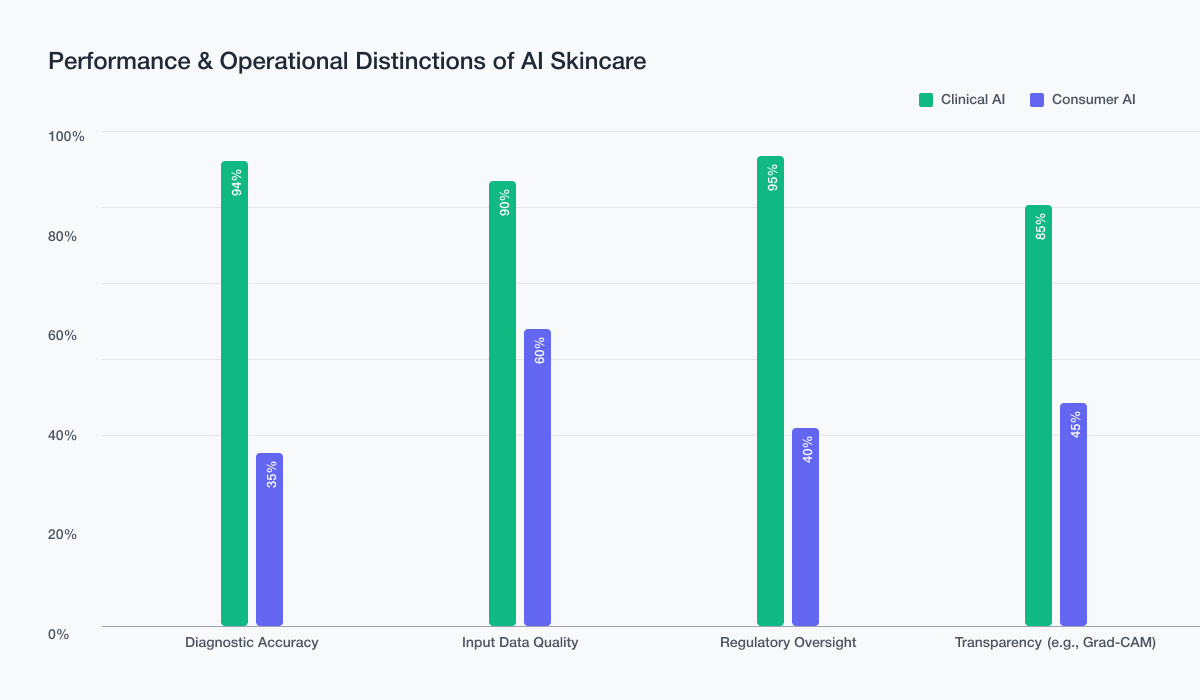
This distinction is clear in their performance benchmarks. In rigorous clinical trials, AI has demonstrated the ability to classify melanoma from dermoscopic images with an accuracy on par with trained dermatologists. One Xception-based model achieved 94.0% accuracy in identifying skin cancer, a testament to its training on highly controlled, clinical-grade imagery (PMC NCBI 2024). Consumer apps, while increasingly sophisticated, work with standard smartphone photos and are geared toward accessibility, not medical diagnosis.
| Feature | Clinical Diagnostic AI | Consumer Wellness AI |
|---|---|---|
| Primary Goal | Disease detection (e.g., melanoma) | Aesthetic improvement & product recommendation |
| Input Data | High-resolution, dermoscopic images | Standard smartphone photographs |
| Key Metric | Diagnostic accuracy, sensitivity, specificity | User engagement, perceived improvement |
| Accountability | Medical-grade, often requires regulatory oversight | Varies by provider; not a medical device |
In a clinical setting, transparency is non-negotiable. A dermatologist must understand why an AI reached a certain conclusion. To facilitate this, advanced models use interpretability techniques like Grad-CAM, which generates a "heatmap" over an image to highlight the specific visual features the algorithm identified as suspicious. This creates a collaborative dynamic where the AI provides a data-driven second opinion, enhancing the clinician's confidence.
Consumer tools, on the other hand, prioritize a seamless user experience. Their goal is to translate a photo into actionable, easy-to-understand recommendations for a daily routine or a new serum. While backed by data, their conclusions are advisory and focused on achieving visible improvements in skin texture and tone over time, a core principle behind modern AI skincare platforms.
While one branch of AI operates as a precision instrument in the hands of a medical expert, the other acts as a personalized guide for your daily skincare journey.
The Unseen Bias: AI's Struggle with Skin Tone Diversity
An AI model is not inherently objective; it is a reflection of the data it was trained on. If that data is skewed, the AI’s conclusions will be too, creating a significant flaw in its logic.
This is the core of algorithmic bias in dermatology. When an AI is predominantly trained on images of light-skinned individuals, its ability to accurately analyze darker skin tones becomes severely compromised. This is not a minor technical issue; it has profound, real-world consequences. For people of color, this can lead to missed or delayed diagnoses of serious conditions like melanoma, where early detection is critical for a positive prognosis.
The evidence for this data imbalance is well-documented. Analyses of major public datasets used to develop dermatological AI have repeatedly confirmed that they are overwhelmingly composed of images from individuals with lighter skin tones. This systemic failure, a key issue in AI ethics, perpetuates a dangerous gap in healthcare equity, as the very tools designed to improve diagnostic access can fail the populations that might benefit most. The result is a technology that performs unreliably for a significant portion of the global population.
Note: An AI cannot accurately identify what it has not been sufficiently trained to see. Without a diverse dataset, it develops blind spots that can lead to diagnostic errors and reinforce health disparities.
Fortunately, the research community is actively working to correct this imbalance. The most direct solution involves concerted efforts to build new, ethically sourced image libraries that are truly representative of all skin tones. This is a complex and resource-intensive process. In parallel, computer scientists are developing innovative AI techniques to create high-quality synthetic data. Methods like style transfer and deep blending can realistically render pathologies on a wide spectrum of underrepresented skin tones, helping to fill the gaps in existing datasets and train more equitable models.
Addressing this data diversity crisis is not just a technical challenge but an ethical imperative for ensuring AI in skincare is safe, effective, and fair for everyone.
The Future is Collaborative: AI, Dermatologists, and You
The rise of AI in skincare does not signal the end of the dermatologist's role, but rather the beginning of a powerful new partnership. The future is not about replacement; it is about augmentation.
The most promising vision for this technology is one where AI functions as a collaborative tool, enhancing the capabilities of both medical professionals and individuals. For dermatologists, AI can act as a "digital assistant," providing a rapid, data-driven analysis of a skin lesion to support their own expert judgment. This can increase diagnostic confidence, streamline workflows, and allow specialists to focus their attention on the most complex cases.
This collaborative model extends beyond the specialist's office. AI is poised to play a crucial triage role in primary care, helping general practitioners make more informed decisions about which cases require urgent referral. This is particularly vital in underserved areas with limited access to dermatological expertise. For consumers, the evolution is toward predictive and proactive care. The four key pillars of this collaborative future include:
- The Dermatologist's Assistant: AI provides a real-time second opinion, improving diagnostic accuracy and efficiency. Studies have shown that AI support can significantly improve a dermatologist's sensitivity in detecting melanoma, a topic often discussed by groups like the American Academy of Dermatology.
- The Primary Care Triage Tool: AI helps non-specialists identify high-risk lesions, ensuring patients who need immediate attention are prioritized and referred correctly.
- The Predictive Personal Advisor: Consumer AI will move beyond reacting to current conditions, instead analyzing trends in your skin and lifestyle to forecast potential issues and recommend preventative care.
- The Integrated Health Hub: True hyper-personalization will arrive when AI can synthesize skin image analysis with other data streams, such as genetic predispositions, local environmental factors, and lifestyle habits, for a truly holistic recommendation.
Of course, significant challenges remain. Ensuring model robustness across diverse populations, navigating the complex landscape of regulatory approval for clinical tools, and building trust with both doctors and patients are ongoing priorities (MDPI Diagnostics 2023). The path forward requires careful innovation and a steadfast focus on creating a system that empowers, rather than replaces, human expertise.
Ultimately, the goal is to create a seamless ecosystem where intelligent tools empower clinicians and individuals to work together toward better skin health for all.
As we've journeyed through how AI learns your skin, it is clear that the path from raw data to a radiant glow is paved with sophisticated technology. The integration of artificial intelligence is fundamentally reshaping our understanding of skin health, moving us towards a future where care is not just effective, but truly tailored to the individual.
Here are the key insights we have uncovered:
- Data is the Foundation: AI in dermatology thrives on extensive datasets of skin images, utilizing advanced deep learning models like Convolutional Neural Networks to meticulously analyze everything from texture to lesion characteristics.
- Transformative Applications: From offering hyper-personalized product recommendations to enabling early detection of serious skin conditions, AI's real-world impact, supported by platforms like Nvidia AI, is profound and growing.
- Addressing the Nuances: Ensuring data diversity across all skin tones and building models that are transparent and trustworthy remain critical areas of focus for ethical and effective AI development.
AI represents a significant leap forward, offering a more precise and responsive approach to managing our skin’s health by blending advanced computation with the delicate art of dermatology.
Ready to explore how these AI-powered insights can inform your personal skincare journey? Take the next step towards understanding your unique skin with tools designed to offer truly tailored care and guidance.
Tags
Related Articles

Unlock Your Natural Glow: AI's Holistic Approach to Skin Health

AI Skin Profiling: Your Essential Guide from Data to Dermatologist