Routine Coherence Why Good Products Need Working Order
Read about Routine Coherence Why Good Products Need Working Order on Cosmi Skin

Most skincare advice stops at the product. Buy a niacinamide serum for pores. Buy a vitamin C serum for brightness. Buy a retinol for fine lines. Each pick is defensible in isolation, but when you stack them on the same bathroom shelf and try to use them across the same day, the picture changes. The right ingredients at the wrong times, or in the wrong order, or in redundant doses, can quietly cancel each other out. Dermatologist guidance from Cleveland Clinic puts it plainly: "Apply them out of order, mix the wrong products or use too many, and your skin will feel the consequences."
That gap between good products and a working routine is exactly what we mean by routine coherence inside Cosmi's product suggestions. It is not a separate feature, and it is not a marketing word. It is the principle our recommendation engine follows when it places a product at a specific step inside your generated morning, afternoon, or evening routine. The rest of this article breaks down what coherence actually checks for, how it shows up in the routine Cosmi hands you, and where the idea still has honest limits.
TL;DR: Routine Coherence at a Glance
- Coherence is not the same as personalization. Personalization picks the right product for your skin profile. Coherence checks that the products picked across your whole day work together as a single plan.
- Cosmi's suggestions live inside a routine, not a list. Every product recommendation is anchored to a step in your morning, afternoon, or evening routine, which is what makes coherence possible to evaluate in the first place.
- Four checks run underneath: step-to-step compatibility within a routine, time-of-day assignment for active ingredients, cross-routine coverage of each concern without redundancy, and correct application order from thinnest to thickest.
- Coherence closes the loop with tracking. When tracked condition scores change, the engine re-checks coherence before swapping products in or out.
- Coherence has limits. It is a planning check, not a clinical diagnosis. Severe reactions, prescription interactions, and pregnancy-specific routines are outside what a recommendation engine should be deciding on its own.
What We Mean by Coherence
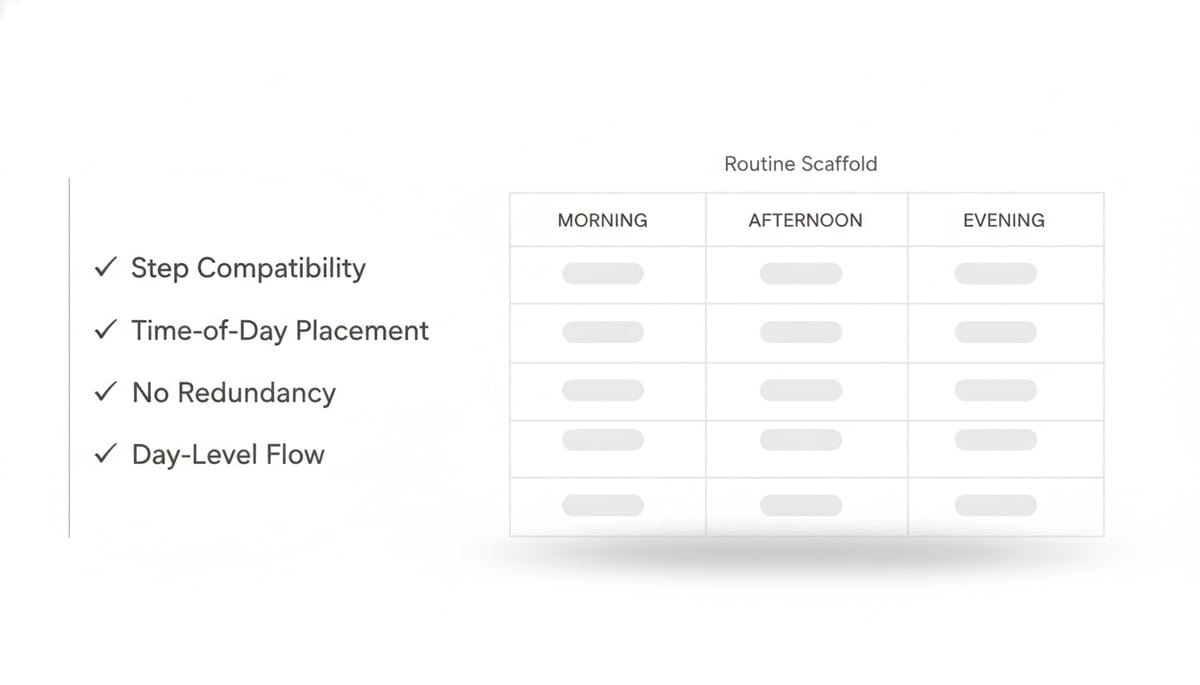
When Cosmi generates a routine, it does not start with a product catalog and try to match your skin to one. It starts with your analyzed skin profile: hydration levels, acne activity, wrinkle signals, and the goals you stated during onboarding. From there, it works outward into a morning, afternoon, and evening structure, the same three-slot routine framework our platform has used since launch. Only after that scaffold exists does the engine place specific product suggestions at each step.
Coherence is the rule set that governs those placements. It asks four questions of every suggested product, every time:
- Does it conflict with the product sitting at the previous step in this same routine? The standard application order is thinnest to thickest so each product can actually absorb. Cleveland Clinic and the American Academy of Dermatology both anchor the order rule, with Cleveland Clinic phrasing it directly: routine steps should run from lightest to heaviest. If our engine suggested a heavy occlusive moisturizer before a water-based serum, the serum would not reach the skin. Coherence rejects that ordering.
- Is this active ingredient in the right time slot? Vitamin C is most useful in the morning because it pairs with sunscreen for daytime defense. Retinol is most useful in the evening because it is photosensitive. Putting a strong retinol in a morning routine is not wrong because of the product itself, but wrong because of when it is being used. We have covered this separation of actives across AM and PM in more detail elsewhere.
- Is the same concern being addressed twice across the day? If your AM serum is already a 10% niacinamide formula targeting pores, the PM routine does not need a second niacinamide-heavy product chasing the same result. Redundant actives are wasteful at best and irritating at worst, especially when stacked with acids or retinoids.
- Does each suggested product leave room for the next routine in the day to do its job? Your afternoon and evening steps are not isolated. A high-strength AHA exfoliant in the evening sets up the morning routine to behave differently than it would otherwise. Coherence checks the day as a system, not three unrelated lists.
Personalization asks "is this product right for your skin?" Coherence asks "is this product right in this slot, on this day, given what is happening in the slot before it and the slot after it?" The first question gets you a sensible shopping list. The second question gets you a routine that is actually likely to work.
How Coherence Shows Up in Cosmi's Routine Output
When you complete a skin analysis on Cosmi and generate a routine, the output is structured. Each time slot has labeled steps, and each step has a product suggestion tied to it. The coherence logic is what determines which product lands at which step, and which products are deliberately left out of the routine entirely.
For a profile that reads as moderate acne combined with a flagged hydration deficit, the morning routine the engine tends to generate looks roughly like this:
| Step | Suggested Product Type | Why It Sits Here |
|---|---|---|
| 1. Cleanser | Gentle, low-pH gel cleanser | Strips overnight buildup without compromising the barrier before serum application |
| 2. Targeted serum | Niacinamide or azelaic acid at moderate concentration | Addresses acne and supports the barrier; safe to layer under hydration |
| 3. Hydrating layer | Hyaluronic acid serum or essence | Pulls water into the skin before an occlusive step locks it in |
| 4. Moisturizer | Lightweight, non-comedogenic | Seals hydration without adding occlusive weight that would interfere with sunscreen adhesion |
| 5. Sunscreen | Broad-spectrum SPF 30 or higher | Final AM step; closes the routine with the daytime protective layer |
The afternoon slot is typically a refresh, not a treatment. A facial mist, blotting papers, sunscreen reapplication, and a lip balm. No new actives. This is a coherence decision: the afternoon exists to maintain, not to introduce more variables into a day that already has a treatment stack running.
The evening routine flips the active ingredients:
| Step | Suggested Product Type | Why It Sits Here |
|---|---|---|
| 1. Double cleanse | Oil-based cleanser followed by water-based | Removes sunscreen and grime from the AM routine so PM actives can reach skin |
| 2. Treatment | Retinoid or exfoliating acid, depending on tracked tolerance | Does the corrective work; placed away from daytime photosensitivity |
| 3. Serum | Hydrating or barrier-supporting (peptides, ceramides) | Soothes and rebuilds after the treatment step |
| 4. Night cream | Richer occlusive moisturizer | Locks the PM stack in during the skin's natural repair window |
Two things to notice. First, the acne-active ingredient only appears once across the whole day, in the slot where it performs best. Second, the heavy occlusive never lands in the morning, where it would interfere with sunscreen. Both are coherence decisions, not personalization decisions. A personalization engine that did not check for coherence might happily suggest a strong retinol in the morning because it is "good for acne." A coherent system refuses to.
Key Takeaway
Coherence is what stops your morning moisturizer from blocking your sunscreen, your AM vitamin C from fighting your PM retinol, and your second acne serum from doubling up on the first. The product pick at each step is downstream of the slot it lives in.
Next Up
How coherence interacts with the tracking layer, so the routine stays coherent as your skin actually changes.
Coherence and Tracking: The Closed Loop
A routine is only as coherent as the assumptions baked into it. If those assumptions stop matching reality, coherence drifts. Cosmi's tracking feature exists to catch that drift before it becomes visible damage.
After each skin analysis, the platform records new scores for the same conditions it measured at onboarding: acne activity, hydration, wrinkle presence. The next time the routine engine runs, it does not start from scratch. It starts from the new scores and asks the coherence questions again. If hydration has improved but acne is unchanged, the engine might shift the niacinamide step from morning to evening, or rotate a heavier moisturizer out in favor of a lighter one, because the routine's internal balance has changed.
This matters because coherence is not static. A routine that was perfectly coherent for a skin profile in January can become incoherent by April, not because the products got worse, but because the skin got better in one dimension and not in others. Routine generators that recommend once and never revisit produce exactly this kind of silent staleness. Cosmi's engine re-checks on every analysis.
We have written separately about how the tracking reports themselves work and how to interpret the condition deltas. The point worth keeping for this article is simply that coherence is a check that gets re-run, not a check that runs once.
Where Coherence Has Limits
Coherence is a planning discipline. It is good at catching ordering mistakes, redundant actives, and time-of-day misplacements. It is not a clinical tool, and we want to be straight about that.
- Coherence cannot diagnose. If a patch of skin behaves in a way that points toward eczema, rosacea, or any condition that needs medical evaluation, the routine engine should not be the system making that call. The platform's role is to support skincare; it is not to replace a dermatologist. Our positioning on AI vs an in-person dermatologist covers the boundary in more detail.
- Coherence does not know your prescriptions. If you are using tretinoin, isotretinoin, or any prescription topical, our engine cannot see that medication in your routine. We surface a clear prompt to add prescription products manually so the coherence check can account for them, but the system is only as accurate as the information it has.
- Coherence is conservative on purpose. The engine prefers AM/PM separation of strong actives, lower concentrations first, and slower introduction of new treatment steps. For users who already have an established routine, this can feel underpowered. That is intentional. Coherence is built to protect the routine from breaking; it is not built to push the most aggressive option first.
- Coherence does not extend across other people's products. If you are using a moisturizer that was not suggested by Cosmi, the engine has no visibility into it. The coherence check applies to the routine Cosmi generated and to anything you have told the platform you are using. Outside products are outside the check.
None of these limits are dealbreakers, but each one is a reason to treat coherence as a planning aid rather than an authority.
What to Look for in Any Routine Generator
Even if you never use Cosmi, coherence is a useful lens for evaluating any AI-driven routine recommendation. The questions worth asking of any tool that hands you a skincare plan are simple:
- Does the recommendation sit inside a routine, or is it a list? Lists cannot be coherent. They are just picks. Coherence requires structure, and structure requires a routine scaffold.
- Does the tool tell you why a product sits where it sits? If the answer is only "good for your skin type," the check is shallow.
- Does the tool separate strong actives across AM and PM? If the same active appears at the same intensity in every time slot, the system is not reasoning about time-of-day placement.
- Does the tool re-check the routine when your skin changes? A one-time recommendation is a snapshot. Coherence is a process that has to be re-run.
Cosmi's product suggestions aim to satisfy all four. The coherence logic underneath each routine is what makes the suggestions a plan rather than a catalog, and it is what makes the plan worth following.
If you want to see what a coherent routine looks like for your own profile, the fastest path is a fresh skin analysis on Cosmi, followed by a routine generation. The output will tell you, step by step, why each suggested product sits where it does. That transparency is the whole point of running coherence as a visible check rather than a hidden one.
Tags
Related Articles

Beyond Generic: Cosmi's AI Cosmetologist Crafts Your Perfect Skincare

Your Day, Your Skin: Crafting Routines with Cosmi's AI Expert